Most people meet AI through a chat box.
That is a reasonable place to start. A chat box is immediate, flexible, and forgiving. You can ask a question, paste a fragment, change your mind, and get something back.
For a while, that feels like the whole thing.
Then real work starts passing through it.
A decision gets made. A source gets summarised. A fix is discovered. A task is delegated. A reminder is set. A loose idea starts to become something with shape.
And the problem changes.
The question is no longer: can the model respond?
The question is: where does the work land?
Does the decision update the source of truth?
Does the fix become easier next time?
Does the delegated task get watched, or does it become one more thing the human has to remember?
Does the system know when to interrupt, and when to stay quiet?
This is why I built Bob and Control Tower.
Not because I wanted a chatbot with a name.
Because chat alone was too leaky for the way real work actually happens.
One role, many lanes
The name is a small nod to Dennis E. Taylor’s Bobiverse novels, where one originating intelligence grows into many specialised, distributed versions of itself, each taking on different work while still belonging to the same identity. That gave me a useful shape to build toward.
There is one Bob in the sense that there is one operating role: the thing that helps work move from intent to outcome. But there can be many specialist lanes underneath that role; a research lane, a memory lane, a verification lane, an SRE lane, a lane for whatever topic area has enough repeated work to deserve one.
Sometimes Bob answers directly. Sometimes Bob writes a note, turns a conversation into a task, hands work to a specialist lane, or watches a long-running process so the human doesn’t have to keep it in their head. Sometimes Bob says nothing, because nothing needs the human’s attention.
That last part matters more than it sounds. A useful agent system isn’t the one that talks the most. It’s the one that knows what kind of work is happening, which lane should handle it, and what the human actually needs from it.
Control Tower as the landing surface
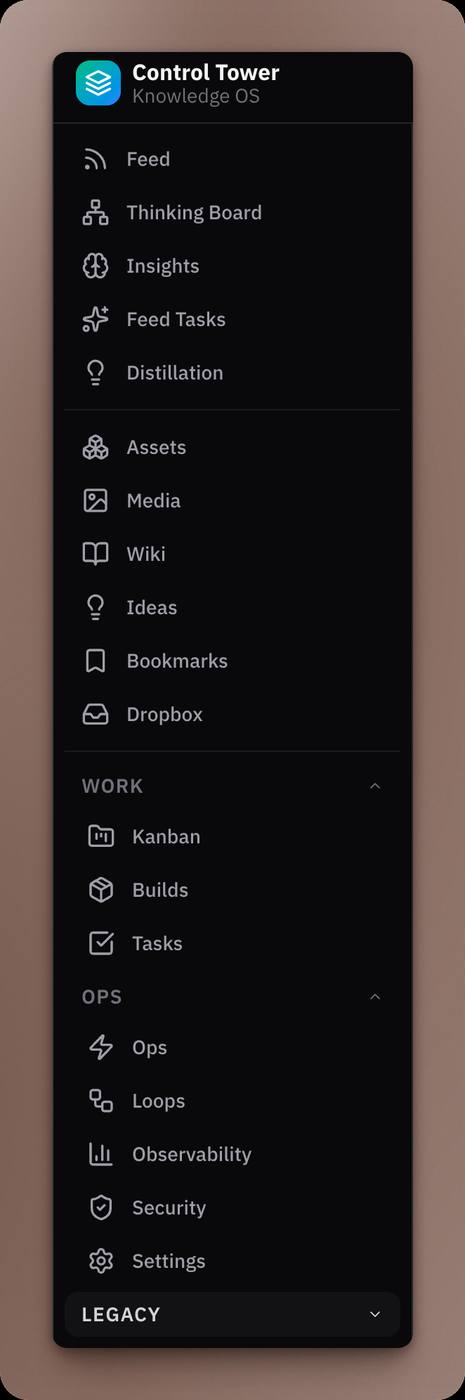
If Bob is the operating role, Control Tower is the landing surface. It exists because work needs somewhere to go.
A conversation can be the entry point, but it can’t be the only place the work lives. Conversations are good for intent, correction, judgement, and momentum. They’re bad as the only source of truth.
Control Tower became the place where the system could preserve shape: what is this piece of work? What’s its current state? What evidence exists? What did we learn? What should happen next? Which lane owns the next move?
The important shift wasn’t adding a dashboard for the sake of a dashboard. It was giving work a memory surface. Without that surface, every useful exchange risks dissolving back into the transcript; it might have helped in the moment, but it doesn’t compound. With it, a conversation can become a decision, a runbook, a watcher, a fix, a task, a verified outcome, or a better future default.
The missing layer was never another model
It’s tempting to explain progress in AI systems by pointing at the model. The model got faster, smarter, cheaper. It can use tools now. All of that matters.
But the lesson from building Bob and Control Tower is that the missing layer was never simply “a better model.” It was operational. A useful loop needs: intent capture, routing, execution, verification, memory, and a next loop that starts smarter.
Most chat tools handle the first part well. Some help with the third. The rest is where real reliability starts to appear.
If there’s intent but no route, everything becomes another chat message. If there’s action but no verification, the human has to supervise the system manually. If there’s verification but no memory, the same issue returns as if nothing was learned. If there’s memory but no operating rhythm, you get a library, not leverage.
A small example of the shape
A home-infrastructure issue is a good test of this.
When something breaks at home, the first symptom is often vague. A service is unavailable. A device stops reporting. A dashboard goes stale. A generic assistant can give you a troubleshooting checklist; that can help, but it still leaves the human carrying most of the context. What changed recently? Which machine owns that service? Has this happened before? What fixed it last time? What shouldn’t be touched without approval?
This is where an operating layer starts to feel different. SRE Bob isn’t just answering the question in front of it; it has a lane. It knows the kind of system it’s looking at, checks the current state against prior notes, avoids known traps, and turns the result into a reusable runbook instead of another one-off rescue.
In one case, SRE Bob took a vague home-infrastructure failure that could have turned into hours of wandering and narrowed it down to the likely class of issue; checking the evidence, applying or guiding the safe fix, confirming the system was healthy again, and recording what to try first next time.
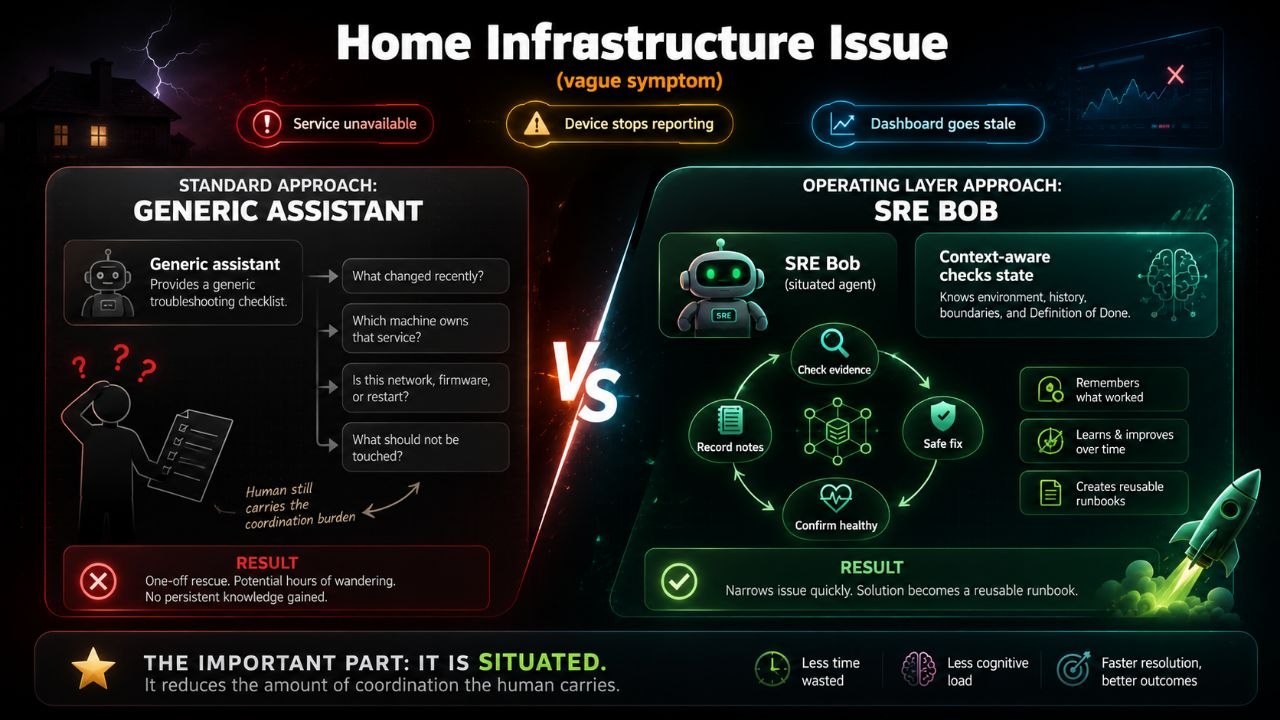
The important part isn’t that the agent is magically clever. It’s that it’s situated: it knows enough about the environment, the history, and the boundaries to reduce how much coordination the human has to carry.
Why this matters
The promise of AI is often described as speed; do more, draft faster, automate more. Speed is useful, but it isn’t the deepest gain.
The deeper gain is reducing the amount of invisible coordination a human has to carry: the open loops, the half-remembered fixes, the “did that actually get done?” checks, the source notes that never become reusable. A human can manage all of that for a while, but it’s expensive and doesn’t scale. The operating layer starts paying off when it absorbs some of that burden without hiding the evidence; not by pretending the human is no longer needed, but by making the human’s attention more valuable.
Protecting attention
A bad notification is not dramatic, but it is revealing. One early alert was technically correct and practically useless: a check failed for a moment, but there was nothing for me to decide.
The fix was not to make that alert quieter. The fix was to change the loop: re-check first, classify the failure, apply the safe recovery if there is one, and only interrupt me if there is still a decision to make.
That is the bit I care about. Bob is not here to replace judgement. It is here to protect it.
Control Tower is where that learning lands.
The longer it runs, the less often we start from zero.